
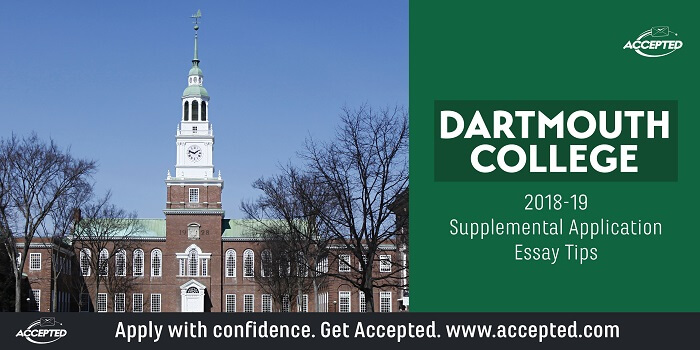
Dartmouth College, like the other Ivy League schools, accepts both the Common Application and the Coalition Application. Regardless of the application you select to use, you will be asked to respond to the same essay prompts. In addition, Dartmouth also requires supplemental essay responses. The additional essays help the admission committee round out the overall picture of you as a prospective student by providing insight into your personality. Don’t approach this as just another essay you have to write. Look at this as an opportunity for you to make a convincing statement about why Dartmouth is the ideal school for you to achieve your goals and how you can enrich the campus community.
Everyone must answer the first essay prompt but you have a choice to make about which question to address with your second response. As you decide which of the latter essay prompts to answer, allow yourself some time to think about Dartmouth’s comprehensive character. Consider its location in Hanover, New Hampshire; if possible visit the campus and imagine yourself there as an undergraduate. Research the different ways Dartmouth’s curriculum and approaches to education are a good fit for you. Think about the specific activities, programs, or organizations that attract you to Dartmouth. In short, ask yourself “Why is Dartmouth the best place for me to achieve my goals?”
Dartmouth reflects its commitment to assess your potential as a student on the Dartmouth campus in its request for a peer recommendation. Dartmouth suggests you include a letter of recommendation from a friend, classmate, family member, or someone else you regard as your peer. This endorsement provides insight into how you are perceived by others. It also gives some indication about how you might fit in with the Dartmouth community.
Dartmouth prides itself on learning without boundaries. The overall academic structure and approach at the school is intended to allow you freedom. The year-round quarter system offers flexibility for you to design your own calendar. You can enter any major without a need for institutional approval (this includes Engineering). How might this sort of structure contribute to your educational success? Students are encouraged to: “Challenge yourself. Be yourself.” Don’t worry about choosing an uncommon topic. Instead, focus on discussing whichever topic you select from your point of view. Your essay responses should express your individual story and reflect your personality.
The Dartmouth Writing Supplement
Dartmouth’s writing supplement requires that applicants write brief responses to two supplemental essay prompts as follows:
Dartmouth College Short Essay #1
Please respond in 100 words or less:
While arguing a Dartmouth-related case before the U.S. Supreme Court in 1818, Daniel Webster, Class of 1801, uttered this memorable line: ”It is, Sir…a small college. And yet, there are those who love it!” As you seek admission to the Class of 2023, what aspects of the College’s program, community, or campus environment attract your interest?
In short, “why Dartmouth?” How is Dartmouth special to you? You have a limited number of words to work with, so be succinct. Remember, they already have your letters of recommendations (counselor, teachers and peer), grades, SAT/ACT/AP/IB scores, curriculum, and list of extracurricular involvement. This question asks you to focus on your personal and/or academic goals and how Dartmouth is a good match for you and vise versa. How will a Dartmouth education prepare you for your future? Consider the factors that make the Dartmouth program, community and campus environment unique and how those factors will support your aspirations.
Dartmouth College Short Essay #2
Please choose one of the following prompts and respond in 250-300 words:
A. ”I have no special talent,” Albert Einstein once observed. ”I am only passionately curious.” Celebrate your curiosity.
Although they made significant changes to the other essay prompt options from last year, this one has only a slight variation. They removed the word “intellectual” to define your curiosity. This alteration is an effort to broaden the scope of the question. This is an opportunity to discuss your passion for a particular area (academic or otherwise) and how you learn best. Provide an example of something that attracted your interest and then discuss the path you took to embrace your curiosity. What sparked your interest? What made the topic / activity / information / concept / question so meaningful to you? How did you explore the subject more deeply? What did you discover? What did you learn about yourself? Consider your learning style and how you approach new concepts. Also think about the connection you established to the subject—what might that reveal about your personality? How did this process inspire you? Make sure to convey your passion for the subject and your enthusiasm for learning!
B. The Hawaiian word mo’olelo is often translated as “story” but it can also refer to history, legend, genealogy, and tradition. Use one of these translations to introduce yourself.
What is your personal story? This question allows you to showcase specific conditions, situations, and/or circumstances in your background that are significant to your identity. Share something fundamental about yourself your family or your intimate community. You can discuss the intricacies of your cultural, familial and/or social background—tell your story. Sometimes it might be something obvious, other times it might be disguised or hidden in some way. Do you feel pressure based on a set of arbitrary characteristics? Do you feel judged or liberated in some way? What is important to you? How does this relate to your values and sense of cultural identity? As you discuss your story, remember to address why it is significant for others to know this about you. Spend a good portion of your essay discussing how this story relates to your sense of identity. What does this reflect about you? How does your past influence who you are and your goals for the future? How do you reconcile finding a sense of belonging on your own terms? How might attending Dartmouth impact your story?
C. “You can’t use up creativity,” Maya Angelou mused. “The more you use, the more you have.” Share a creative moment or impulse—in any form—that inspired creativity in your life.
This prompt creates a space to discuss your passion, imagination, and motivation. In this modern technological world, how do you think outside of the proverbial box? Capture a specific moment or urge that sparked your vision. This may be an opportunity to incorporate discussion about an extracurricular interest/activity that demonstrates your creativity. Think about the ideas or values that inspire you and the ways in which you express your imagination. What have you learned about yourself through your exploration? Then discuss how that influences your sense of identity and perspective about the world. What does what you learned in this creative process reveal about the person you are? How might this effect how you embrace the future? How might you apply this energy going forward? How might you express your creativity and embrace your imagination at Dartmouth?
D. In the aftermath of World War II, Dartmouth President John Sloane Dickey, Class of 1929, proclaimed, “The world’s troubles are your troubles…and there is nothing wrong with the world that better human beings cannot fix.” Which of the world’s “troubles” inspires you to act? How might your course of study at Dartmouth prepare you to address it?
This question targets active engagement not passive thoughts. You can address any problem, large or small. Think about the global community, humanitarian efforts, or any issue you would like to fix. You can tie this response to community service activities, thoughts about empathy, discussions about agency, and individual responsibility. Consider how you view yourself in relationship to those around you. Why are you inspired to solve this problem? Why is it significant? This response reveals your approach to problem solving, ability to conceive solutions, and illustrates how you process the world around you. This is an opportunity to demonstrate your values, critical thinking skills and creativity. What might you learn at Dartmouth that will help you to solve this problem? Discuss how an education at Dartmouth can help you achieve your goals to bring about positive change and fix this dilemma.
E. In The Bingo Palace, author Louise Erdrich, Class of 1976, writes, “…no one gets wise enough to really understand the heart of another, though it is the task of our life to try.” Discuss.
The focus of this prompt allows you to discuss the relationship between true empathy and intellectual thought. Then consider what you might learn about yourself in the process of trying to understand others. Think about efforts to identify with others from their perspective and the impossible challenge of truly putting yourself into someone else’s place—consider the contextual complexities of individuals and the limits of understanding. You could discuss a time where although you acted thoughtfully the outcome was poor or even when someone misunderstood you. This is really about why you think striving for empathy is important even if it is ultimately unattainable. Consider compassion, empathy, and understanding in terms of interpersonal and global impact. Can you discuss a specific incident? What was at stake? What was the outcome? What was the cost to you? What did you learn through the experience? How does what you learned impact the way you view and engage the world? Why is striving for empathy essential to humanity?
F. Emmy and Grammy winner Donald Glover is a 21st century Renaissance man—an actor, comedian, writer, director, producer, singer, songwriter, rapper, and DJ. And yet the versatile storyteller and performer recently told an interviewer, “The thing I imagine myself being in the future doesn’t exist yet.” Can you relate?
This prompt sets the stage for you to exercise your imagination as you consider what you might become in the future. Do you feel like you just don’t fit into a particular category? Do you feel like there is something else out there but you just don’t know what it is yet? Think about your skills and interests, dreams and possibilities, and how those elements might combine to form something new. How might an education at Dartmouth prepare you for the unknown future? What kinds of skills, ways of thinking, and experiences will help lay the foundation for success? How does a liberal arts education play into your plans? Remember Dartmouth prides itself on providing flexibility in learning and an education without boundaries—here’s your chance to tell them why that’s so important to you!
Note: if you have unusual curricular patterns, your counselor can mention this in the Secondary Education Report or you can discuss your circumstances in the “Additional Information” section of the Common Application.
The context of your academic success is a significant factor in determining your overall competitiveness as an applicant. The top applicants take the most rigorous curriculum available at their high schools. Furthermore, by achieving high grades, they demonstrate their ability to thrive in Dartmouth’s challenging academic environment. Dartmouth embraces a holistic approach to the admission process and is committed to reviewing all aspects of your application. Keep in mind; it received 22,033 undergraduate applications for the class of 2022. Only 1,925 or 8.7% were offered admission and 97% were ranked in the top 10% of their high school graduating class with an average SAT score of 1497, and an average ACT score of 33. Your essays are your opportunity to pull away from this extremely competitive applicant pool.
Although it is easy to get overwhelmed, remember to stay focused on your goals. Allow yourself enough time to reflect on your experiences in a unique way that expresses your personality. Meet all deadlines and word limits. You overall application should clearly reflect your interests and motivations while enthusiastically demonstrating why Dartmouth is the best school to help you achieve your objectives!
If you’re applying to Dartmouth College, you already know you’re up against tight competition. Don’t be overwhelmed. Get the guidance of an experienced admissions specialist who will help you stand out from the highly competitive applicant pool so you can apply with confidence, and get accepted! Click here to get started!
***Disclaimer: Information is subject to change. Please check with individual programs to verify the essay questions, instructions and deadlines.***

 By Marie Todd, Accepted's college admissions specialist. Marie has worked in college admissions for over twenty years. She has both counseled applicants and evaluated applications. Most recently she evaluated 5000+ applications for the University of Michigan’s College of Literature, Science and the Arts; College of Engineering; School of Kinesiology. She is available to assist you (or your child) with your applications. Want Marie to help you get accepted? Click here to get in touch!
Related Resources:
• 5 Fatal Flaws to Avoid in Your College Application Essays, a free guide
• Different Dimensions of Diversity, a podcast episode
• School-Specific Common App Supplemental Essay Tips
The post Tips for Answering the Dartmouth College Supplemental Essay Prompts appeared first on Accepted Admissions Blog.

No comments:
Post a Comment